Artificial intelligence is rapidly becoming part of everyday professional work. In 2026, knowing how to use AI is no longer limited to software developers and data scientists. Doctors are using AI-supported tools in healthcare, analysts are combining AI with data and automation, and marketers are using generative AI to improve content, research, personalization and campaign performance.
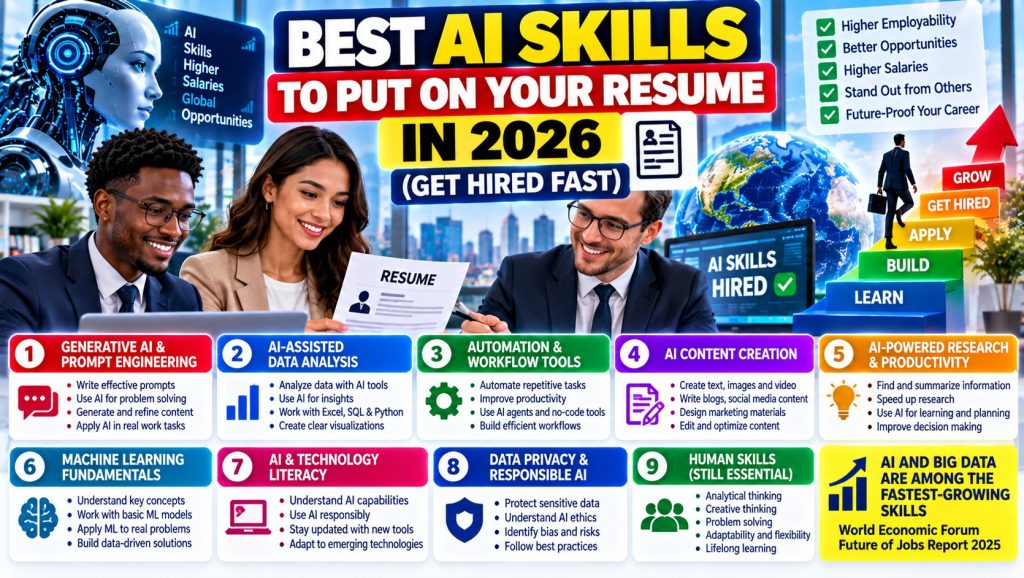
The World Economic Forum’s Future of Jobs Report 2025 identifies AI and big data as the fastest-growing skills, followed by networks and cybersecurity and technological literacy. At the same time, employers continue to value human capabilities such as analytical thinking, creative thinking, resilience, flexibility and lifelong learning.
This means professionals do not necessarily need to become AI engineers. Instead, they need to learn how to use AI effectively within their own profession.
Here are the most important AI skills for doctors, analysts and marketers to develop in 2026.
1. AI Literacy
The first skill every professional needs is basic AI literacy.
You should understand:
- What generative AI is
- How AI models produce results
- What AI can and cannot do
- How to write effective prompts
- How to check AI-generated information
- How AI can introduce errors or bias
- When human judgment is necessary
- How to protect confidential information
AI literacy is becoming a foundational workplace skill because professionals increasingly interact with AI-powered software without necessarily being AI specialists.
The goal is not simply to know how to open an AI chatbot. It is to understand when AI is useful, how to use it responsibly and how to evaluate the result.
AI Skills Doctors Need in 2026
Healthcare is one of the areas where AI skills require particularly careful application because decisions can affect patient safety.
The American Medical Association reports that physicians are increasingly using AI for tasks such as documentation, billing-related work, clinical notes, translation and decision-support activities.
2. Healthcare AI Literacy
Doctors should understand the basic capabilities and limitations of AI systems used in healthcare.
This includes knowing how to:
- Evaluate AI-generated information
- Understand clinical AI workflows
- Recognize potential model limitations
- Identify inappropriate outputs
- Verify important information
- Understand how AI fits into clinical practice
AI should support professional judgment rather than replace it.
The AMA’s 2026 AI Evaluation Guide emphasizes evaluating the clinical use case, training and validation data, risks, performance, workflow integration and ongoing monitoring.
3. AI-Assisted Clinical Decision Support
Doctors increasingly need to understand how decision-support systems can assist with clinical workflows.
Examples can include:
- Reviewing large amounts of patient information
- Identifying patterns
- Supporting differential diagnosis
- Summarizing clinical information
- Monitoring patient data
- Supporting evidence-based research
However, AI output should be treated as assistance rather than unquestionable medical advice.
Physicians remain responsible for applying clinical expertise and considering the individual patient.
4. AI for Medical Documentation
Documentation is another important area.
AI-powered tools can help with:
- Clinical note drafting
- Summarizing conversations
- Preparing discharge instructions
- Organizing documentation
- Reducing repetitive administrative work
The AMA has identified reducing administrative burden through automation as a major opportunity for healthcare AI.
Doctors therefore benefit from learning how to review, edit and safely approve AI-generated documentation rather than simply accepting it automatically.
5. AI Ethics, Privacy and Patient Safety
This may be one of the most important AI skills for healthcare professionals.
Doctors should understand issues involving:
- Patient privacy
- Data security
- Bias
- Transparency
- Accuracy
- Accountability
- Clinical validation
- Human oversight
The AMA has emphasized that health AI should be transparent, validated, responsible and equitable, with patient safety remaining central to implementation.
AI Skills Analysts Need in 2026
Data and business analysts are among the professionals who can benefit significantly from AI because their work already involves information, patterns, reporting and decision-making.
6. AI-Assisted Data Analysis
Analysts should learn how to use AI to accelerate parts of the analytical workflow.
AI can assist with:
- Exploring datasets
- Generating analysis ideas
- Identifying patterns
- Writing formulas
- Creating SQL queries
- Explaining statistical concepts
- Summarizing findings
- Preparing reports
However, analysts should verify AI-generated calculations and conclusions.
AI can produce confident but incorrect answers, so professional data validation remains essential.
7. Python and AI-Assisted Programming
Analysts do not necessarily need to become full-time software developers, but Python can significantly expand their capabilities.
Useful skills include:
- Python basics
- pandas
- Data cleaning
- Data visualization
- Statistical analysis
- Basic machine learning
- Notebook workflows
- AI-assisted coding
AI coding assistants can help analysts generate or troubleshoot code, but the analyst still needs enough technical understanding to review the output.
8. Data Visualization With AI
Being able to turn raw information into understandable insights remains valuable.
Analysts should learn how to use AI alongside tools such as:
- Excel
- Power BI
- Tableau
- Python visualization libraries
- SQL
- Business intelligence platforms
The valuable skill is not simply producing a chart.
It is understanding which information matters, which visualization communicates it effectively and what business decision the data supports.
9. Prompt Engineering for Analysis
Analysts can improve their productivity by learning how to give AI precise instructions.
Instead of asking:
“Analyze this data.”
A stronger prompt might specify:
“Identify the three largest month-over-month changes, calculate the percentage difference, explain possible patterns and present the findings in a table.”
Good prompts provide context, objectives, constraints and the desired output format.
10. AI-Powered Forecasting and Predictive Thinking
Analysts should also understand the basics of forecasting and predictive models.
Depending on the role, this can involve:
- Demand forecasting
- Sales forecasting
- Customer behavior analysis
- Risk analysis
- Trend detection
- Scenario analysis
The analyst’s responsibility is to understand the assumptions behind a model and communicate uncertainty rather than presenting every prediction as fact.
AI Skills Marketers Need in 2026
Marketing may be one of the professions most visibly transformed by generative AI.
Google’s 2025 research found that AI use has become increasingly important within marketing teams, with AI skills becoming more prominent in marketing job requirements.
11. Generative AI for Content Creation
Marketers should know how to use AI to support:
- Blog ideas
- Social media content
- Email drafts
- Advertising concepts
- Video scripts
- Product descriptions
- Content variations
- Creative brainstorming
But AI-generated content should still receive human editing.
The strongest marketers use AI to increase their creative capacity rather than publishing raw AI output without review.
12. AI-Powered SEO
Search marketing is changing rapidly.
Marketers should understand how AI can assist with:
- Keyword research
- Search intent analysis
- Content outlines
- Competitor research
- Topic clustering
- Content optimization
- Search performance analysis
However, SEO professionals should not focus only on producing more content.
Understanding audience needs, search intent, originality, accuracy and useful information remains critical.
13. AI for Audience Research and Personalization
AI can help marketers analyze customer information and identify patterns.
Useful applications include:
- Audience segmentation
- Customer behavior analysis
- Sentiment analysis
- Personalized recommendations
- Customer journey analysis
- Campaign targeting
Google’s marketing research highlights the growing role of AI in data-driven decision-making and personalization.
14. Marketing Automation With AI
Marketers should understand how AI can connect different parts of a campaign.
Examples include:
- Automated email workflows
- Lead qualification
- Customer support
- Content scheduling
- Campaign analysis
- Ad optimization
- Customer segmentation
The important skill is not simply knowing how to use one AI tool.
It is understanding how different tools can work together to improve a complete marketing workflow.
15. AI Analytics and Campaign Optimization
Modern marketers need to understand performance data.
AI can help analyze:
- Click-through rates
- Conversion rates
- Customer acquisition costs
- Return on advertising spend
- Engagement
- Website behavior
- Sales trends
A marketer who combines creative thinking with data analysis can make better decisions about which campaigns to scale, change or stop.
AI Skills All Three Professions Need
Although doctors, analysts and marketers have different responsibilities, several AI skills are useful across all three careers.
Critical Thinking
Never assume an AI-generated answer is automatically correct.
Ask:
- Is the information accurate?
- What evidence supports it?
- Could there be missing information?
- Does the conclusion make sense?
- What could the model have misunderstood?
The World Economic Forum continues to rank analytical thinking among important skills alongside rapidly growing technology skills.
Data Privacy
Professionals should understand what information can safely be entered into an AI system.
This is especially important for:
- Patient records
- Financial information
- Customer data
- Confidential business documents
- Personally identifiable information
Always follow your employer’s policies and applicable privacy requirements.
Human-AI Collaboration
The most valuable workers may not be those who simply use AI the most.
They are the people who know how to combine AI with professional expertise.
A doctor brings clinical judgment.
An analyst brings analytical reasoning.
A marketer brings creativity, customer understanding and strategic thinking.
AI can enhance these abilities, but professional expertise remains essential.
How to Build AI Skills in 2026
You do not need to learn everything at once.
Start with your existing profession.
Doctors
Begin with healthcare AI literacy, documentation tools, clinical decision-support concepts, AI evaluation and responsible AI.
Analysts
Start with AI-assisted Excel or SQL, Python, data visualization, prompting and predictive analytics.
Marketers
Focus on generative AI, content workflows, SEO, audience analysis, automation, personalization and campaign measurement.
Then build practical projects.
For example:
Doctor: Evaluate how an approved AI documentation tool could fit into a clinical workflow.
Analyst: Use AI-assisted Python to clean and analyze a public dataset.
Marketer: Build an AI-assisted campaign workflow and compare its performance against a traditional process.
Practical experience is more valuable than simply collecting AI certificates.
Do You Need to Become an AI Expert?
No.
Most professionals do not need to become machine-learning engineers.
Instead, aim to become an AI-capable professional in your field.
That means understanding:
Your profession + AI tools + data + critical thinking + responsible use.
This combination can be more valuable than learning AI in isolation.
The World Economic Forum expects technology skills to grow rapidly through 2030, but also highlights creative thinking, resilience, flexibility, curiosity and lifelong learning as increasingly important.
2026 AI Skills Checklist
Doctors
- AI healthcare literacy
- Clinical AI evaluation
- AI-assisted documentation
- Clinical decision-support awareness
- Medical data analysis
- Prompting for healthcare workflows
- AI ethics
- Patient privacy
- Bias and safety evaluation
Analysts
- AI-assisted data analysis
- Python
- SQL
- Data visualization
- Prompt engineering
- Machine-learning fundamentals
- Forecasting
- Statistical reasoning
- Data quality validation
Marketers
- Generative AI
- AI content creation
- AI-powered SEO
- Audience analysis
- Personalization
- Marketing automation
- Campaign analytics
- AI-assisted creative testing
- AI tool selection and management
Final Thoughts
AI skills are becoming increasingly important across professional careers, but the winning strategy in 2026 is not simply to learn as many AI tools as possible.
Professionals should learn how AI applies specifically to their work.
For doctors, that means understanding healthcare AI while protecting patient safety and preserving clinical judgment. For analysts, it means combining AI with data, statistics, programming and business reasoning. For marketers, it means using AI for content, research, personalization, automation and measurement while maintaining creativity and human understanding.
The broader labor-market trend is clear: AI and big data are among the fastest-growing skill areas, but employers still value analytical thinking, creativity, adaptability and lifelong learning.
The professionals who learn to work effectively with AI rather than simply compete against it can put themselves in a stronger position for the changing job market.
In 2026, the most valuable combination is not AI instead of expertise.
It is AI + professional expertise + human judgment.