For many international students, the cost of taking an English-language test can become an additional barrier when applying to universities abroad. The good news is that some scholarships and university programs in 2026 may allow applicants to apply without IELTS, depending on the program, institution, nationality and previous education.
However, students should be careful with the phrase “scholarships without IELTS.” It does not necessarily mean that English proficiency is completely ignored. A university may accept another English test, proof that your previous degree was taught in English, an institutional assessment, or require an approved English test later in the admission process.
This guide explains some of the best opportunities to investigate in 2026 and how to find legitimate fully funded scholarships without unnecessarily taking IELTS.
What Does “Without IELTS” Actually Mean?
A scholarship advertised as “without IELTS” can mean several different things.
You may be able to apply because:
- IELTS is not required for the initial scholarship application.
- The university accepts another English-language test.
- Your previous education was completed in English and the university accepts this as evidence.
- The institution conducts its own English assessment.
- English testing is required only after you are shortlisted.
- The selected program is taught in a language other than English.
The rules are program-specific, so never assume that an entire scholarship program is IELTS-free.
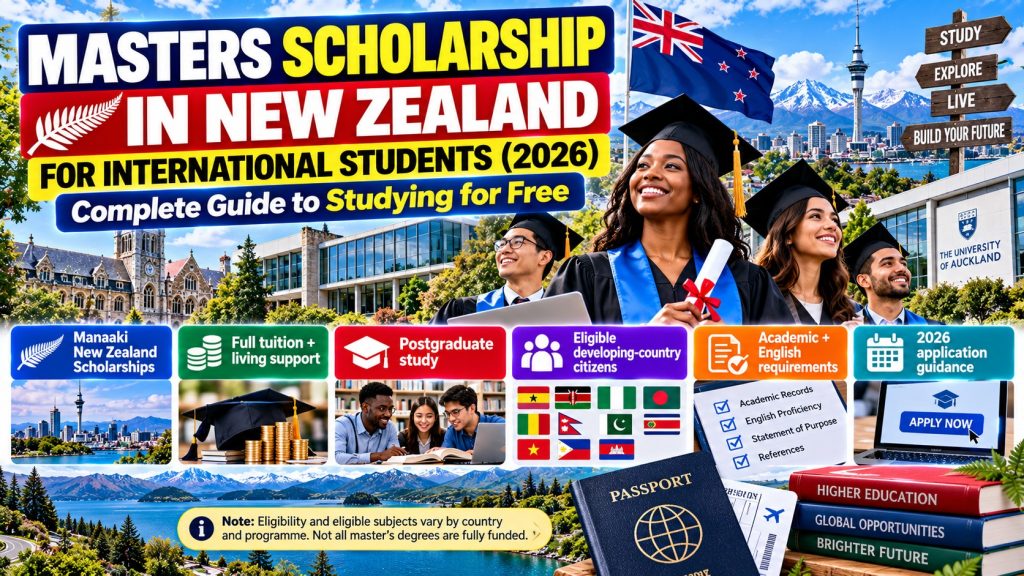
For example, the New Zealand Manaaki Scholarship says shortlisted tertiary applicants must eventually provide evidence of English competency, although English test scores are not required at the initial scholarship application stage.
1. Erasmus Mundus Joint Masters Scholarships
Erasmus Mundus Joint Masters are among the strongest fully funded opportunities for international students seeking master’s study in Europe.
The program is open to students from around the world, and selected master’s programs offer full scholarships to highly ranked applicants. Scholarship support can contribute to participation costs, travel, visa expenses and living costs.
The important point is that there is no single IELTS rule covering every Erasmus Mundus master’s program. Each master’s consortium publishes its own admission requirements, including language requirements.
Therefore, students looking for an opportunity without IELTS should search the individual Erasmus Mundus program websites and check exactly which forms of English evidence are accepted.
The European Commission also announced in July 2026 that 37 new Erasmus Mundus Joint Masters projects were selected, with the new programs expected to open for student applications in autumn 2026.
Typical requirements
Applicants generally need:
- A bachelor’s degree or equivalent
- Strong academic performance
- Relevant academic background
- Motivation statement
- Recommendation letters
- CV
- Academic transcripts
- Proof of language ability where required
Erasmus Mundus states that applicants can generally apply if they already hold a bachelor’s degree or are in their final year and will graduate before the master’s program begins.
2. Manaaki New Zealand Scholarships
The Manaaki New Zealand Scholarship is another major government-funded opportunity for eligible students from participating countries.
The scholarship can support students studying approved programs in New Zealand, but applicants must first check whether their country and preferred subject are eligible.
One useful feature for students concerned about IELTS is that you do not need to submit an English test score when you initially apply for a Manaaki tertiary scholarship. However, shortlisted applicants must later demonstrate English competency and meet the English requirements of their chosen institution.
Manaaki generally accepts approved tests such as IELTS, TOEFL, PTE Academic and Cambridge Academic English at the relevant stage.
So this is better described as “IELTS not required at initial application” rather than a guaranteed IELTS-free scholarship.
3. University Scholarships With English-Test Alternatives
Another excellent strategy is to search directly for university scholarships.
Some universities may offer full or substantial scholarships while allowing applicants to satisfy English requirements through alternatives to IELTS.
Possible alternatives can include:
- TOEFL
- PTE Academic
- Cambridge English
- Duolingo English Test
- Previous English-medium education
- University English assessments
- Other institution-approved evidence
The exact rules differ significantly.
For example, DAAD scholarship information shows that accepted English-language evidence can include several alternatives to IELTS depending on the program, while the specific university can establish its own admission requirements.
This means applicants should not search only for “no IELTS scholarships.” A better search strategy is to look for fully funded scholarships + English requirement alternatives.
4. Scholarships in Germany
Germany has numerous scholarship opportunities for international students, including programs supported through DAAD.
However, DAAD does not operate under one universal “no IELTS” rule.
For English-taught programs, DAAD explains that acceptable evidence may include IELTS, TOEFL, Cambridge English and other recognized qualifications, depending on the program. Universities may also specify exactly what they accept.
Therefore, students should examine:
- The scholarship requirements.
- The university admission requirements.
- The specific master’s program.
- The language of instruction.
- Accepted English-language evidence.
If your previous degree was taught in English, ask the university whether a medium-of-instruction certificate or other evidence can satisfy its language requirement.
Do not assume that it will automatically be accepted.
5. Chinese Government Scholarship Opportunities
China also offers government-supported scholarships for international students, including bachelor’s, master’s and doctoral opportunities.
The important issue is that language requirements can differ considerably between universities and programs.
For example, published Chinese Government Scholarship program information from participating universities can require IELTS or TOEFL for English-taught programs, while Chinese-taught programs may use HSK requirements instead.
This makes China a destination worth researching, but students should verify the exact language requirement for their selected university and course before applying.
Who Can Apply for Scholarships Without IELTS?
The eligibility requirements vary, but many fully funded scholarships look at factors such as:
Academic Performance
A strong academic record can make your application more competitive.
Relevant Study Background
Your previous degree may need to match or relate to the proposed course.
Leadership and Community Involvement
Some scholarships value leadership, volunteering and community development.
Work Experience
Certain postgraduate scholarships require relevant professional experience.
Research Potential
PhD and research-focused scholarships may require a research proposal, publications or evidence of academic research ability.
English Proficiency
Even if IELTS is not required, you may still need to demonstrate that you can successfully study in the language of instruction.
Documents You May Need
Prepare your documents before applications open.
Common requirements include:
- International passport
- Academic certificates
- Academic transcripts
- Curriculum vitae
- Motivation letter
- Statement of purpose
- Recommendation letters
- Research proposal for research programs
- Proof of work experience where applicable
- English-medium instruction letter where accepted
- Alternative English test result where required
- Passport photograph
- Scholarship application form
Keep your documents consistent. Your name, date of birth, educational history and other important information should match across your application.
How to Apply for Scholarships Without IELTS
Step 1: Choose Your Destination
Decide whether you want to study in Europe, New Zealand, Germany, China or another destination.
Step 2: Find a Suitable Scholarship
Use official scholarship portals and university websites rather than relying entirely on social-media posts.
Step 3: Check the Language Requirement
This is the most important step.
Look specifically for statements such as:
- IELTS not required at application stage
- English-medium degree accepted
- TOEFL accepted
- PTE accepted
- Cambridge accepted
- University English test available
- English proficiency assessed after shortlisting
Step 4: Check Academic Eligibility
Confirm that your degree, grades, age, work experience and academic background meet the program requirements.
Step 5: Prepare Your Application
Write a strong personal statement explaining your background, goals, academic interests and why the scholarship matters.
Step 6: Collect Recommendation Letters
Choose referees who can provide specific information about your academic ability, leadership, research or professional performance.
Step 7: Submit Through the Official Portal
Never pay an unknown person simply because they claim they can “guarantee” a scholarship.
Step 8: Prepare for Interviews
Some scholarships conduct interviews before making final decisions. Manaaki, for example, includes an online interview stage in its selection process.
How to Get an IELTS Waiver
If a university accepts an alternative to IELTS, you may need to demonstrate that your previous education was conducted in English.
Possible evidence can include:
- Medium of Instruction certificate
- Previous degree certificate
- Transcript
- Letter from your university
- Alternative English test
However, an English-medium degree does not automatically guarantee an IELTS waiver.
Always ask the university directly whether it accepts your specific qualification as proof of English proficiency.
Beware of Fake “No IELTS” Scholarships
The popularity of scholarships without IELTS has also created opportunities for scammers.
Be suspicious of websites or individuals promising:
- Guaranteed scholarship
- Guaranteed admission
- Guaranteed visa
- “Pay a processing fee and your scholarship is confirmed”
- Fake scholarship letters
- Unofficial application links
- Requests for cryptocurrency payments
- Requests for large upfront consultancy fees
A legitimate scholarship should be verifiable through an official university, government or scholarship-provider website.
Tips for Winning a Fully Funded Scholarship
Competition for fully funded scholarships can be intense.
Improve your application by:
- Applying early.
- Choosing programs that match your academic background.
- Writing a personalized statement.
- Demonstrating measurable achievements.
- Showing leadership and community involvement.
- Getting strong recommendation letters.
- Preparing your documents before the deadline.
- Applying for multiple suitable opportunities.
- Checking every eligibility requirement carefully.
- Following the official application instructions exactly.
Do not apply to a program simply because a social-media post says “IELTS not required.” Read the actual university and scholarship requirements.
Final Thoughts
There are genuine 2026 scholarship opportunities where IELTS may not be required at the initial application stage or where alternative proof of English can be accepted, but there is no universal rule that all fully funded scholarships are IELTS-free.
Erasmus Mundus offers fully funded master’s opportunities worldwide, while individual programs determine their own admission and language requirements. Manaaki New Zealand Scholarships do not require English test scores at the initial tertiary scholarship application stage, but shortlisted applicants must later meet English requirements.
The best approach is therefore to search for scholarships that match your academic profile and then verify the exact language requirement for the individual program.
If you do not have IELTS yet, do not automatically give up on studying abroad. You may have options through alternative English tests, previous English-medium education, university assessments or programs where testing is required at a later stage.
Most importantly, always verify the latest requirements directly with the scholarship provider and university before submitting an application.